Architecture and orchestration
Agent contracts, shared state, evidence ledgers, handoffs, memory boundaries, protected actions, and explicit human authority.
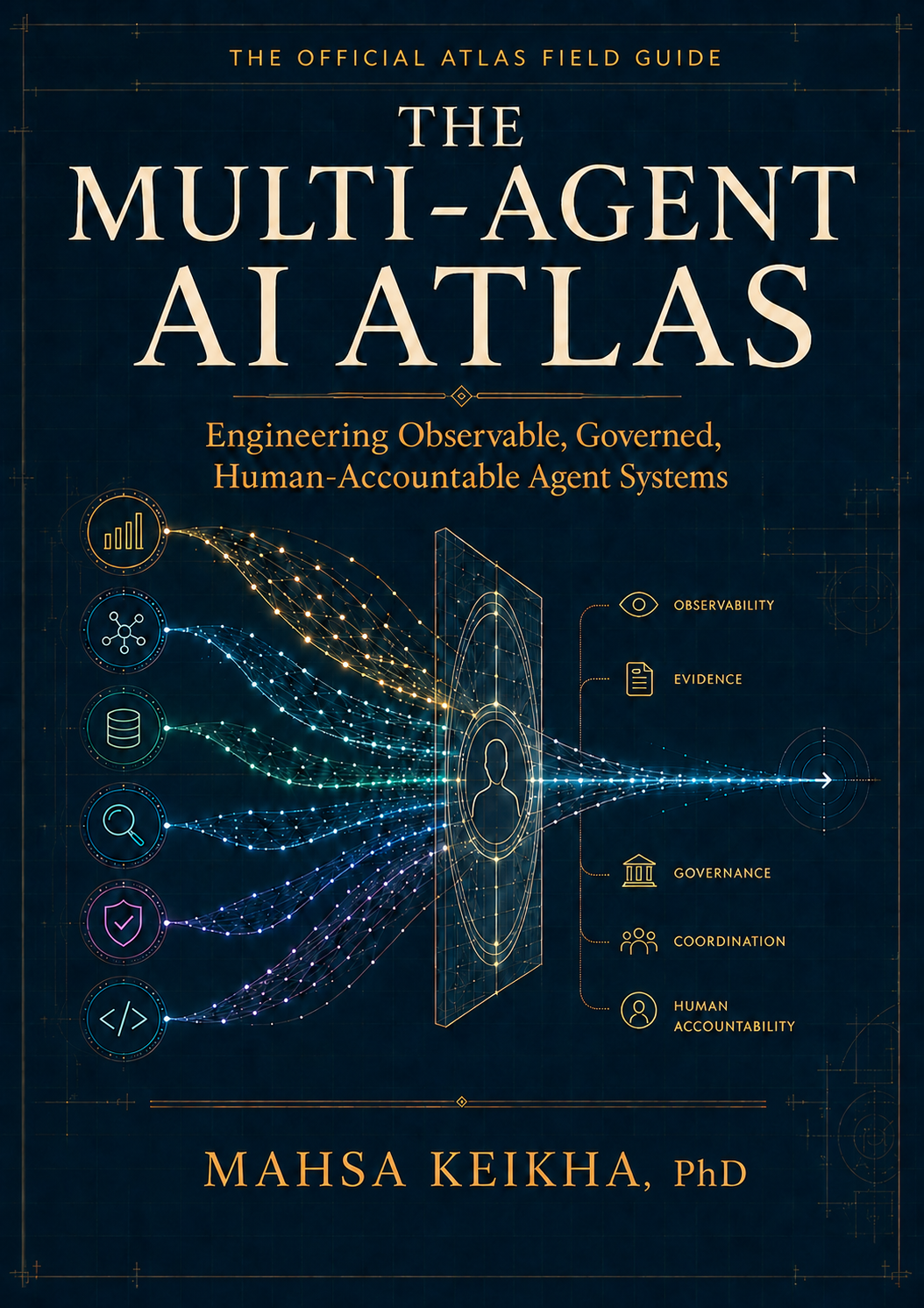
THE OFFICIAL ATLAS FIELD GUIDE
Engineering Observable, Governed, Human-Accountable Agent Systems
This website edition is designed for business owners, engineers, educators, and decision makers. It explains how the 170 systems work, what the public demonstrations prove, how people can pause, redirect, or stop an AI team, and where organization-specific implementation must remain private professional work.
Mahsa Keikha, PhD
INSIDE THE FIELD GUIDE
Agent contracts, shared state, evidence ledgers, handoffs, memory boundaries, protected actions, and explicit human authority.
Deterministic reference implementations, test structure, CI, CodeQL, failure injection, red teaming, and release evidence.
Choose any of the 170 systems, follow its specialist agents in plain language, inspect evidence, and use pause, change, restart, stop, and human decision controls.
How leaders can recognize evidence gaps, authority risks, and the point where organization-specific professional review becomes necessary.
WHY IT EXISTS
A trustworthy agent system should let us inspect the evidence, the handoffs, the permissions, the failures, and the exact point where a person still has authority.
FOR ORGANIZATIONS
Identify the system boundaries, evidence gaps, protected actions, and authority questions that require attention before deployment.
Build shared engineering judgment around orchestration, evaluation, observability, risk, and meaningful human control.
Translate one consequential workflow into a bounded architecture and evidence plan shaped around your organization.
Give leadership a defensible view of priorities, blockers, ownership, and the next responsible investment decision.
OPEN FIELD GUIDE
The public field guide helps teams understand what the Atlas demonstrates and what it does not. Private work begins with the organization's actual workflow, evidence, systems, controls, risks, and accountable decision owners.